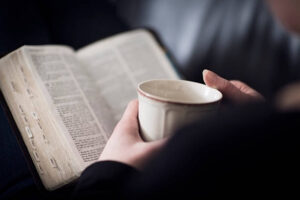
This morning, I woke up early, and as I began thinking about this meditation, I was sitting in the dark, waiting for the sunrise.
Sitting in darkness when you know the light is coming isn’t quite the same as being lost in the dark. I can look out the window and see only vague images, but I know soon the darkness will begin to give way. The horizon will brighten. Shapes will emerge. And eventually, I’ll see clearly.
John’s Gospel leans into imagery of darkness and light, especially when it comes to understanding and faith. It opens with familiar words: “The light shines in the darkness, and the darkness did not overcome it.”
Later, John introduces us to a man who seems to embody that movement from darkness toward light: Nicodemus.
Nicodemus first appears in the third chapter of John’s Gospel. He comes to Jesus at night. John doesn’t tell us why he came at night, but the image is hard to miss. Nicodemus is a respected leader, a man with questions, and he isn’t quite ready to be seen with Jesus, let alone asking questions, in the light of day.
He can hide in darkness.
Then we get to John 7. The religious leaders are looking for ways to condemn Jesus, and Nicodemus speaks up: “Does our law judge people without first giving them a hearing to find out what they are doing?”
It’s not a statement of faith. Nicodemus is simply pointing out, as a lawyer, that an accused is entitled to a hearing. And the others immediately push back. They challenge him, and Nicodemus goes silent and fades back into darkness.
Maybe John is trying to tell us what faith sometimes looks like. Not certainty. Not bold statements. Just one small step toward the light.
And then comes the third appearance of Nicodemus. It’s in John 19. Jesus has been crucified. The disciples have scattered in fear and are nowhere to be seen.
But Nicodemus comes. And this time, he isn’t coming under the cover of darkness. He comes with Joseph of Arimathea to see that Jesus is properly buried. And he brings with him an extraordinary amount of burial spices, enough for a king.
The man who once came to Jesus at night, the man who once went silent when challenged, now comes to the cross openly and in the light.
John never gives us a moment when Nicodemus says, “Now I believe.” There’s no dramatic conversion scene. Instead, John shows us how faith often unfolds.
It starts in darkness. Hesitant questions are asked. Silence and reflection follow. Then, eventually, comes an act of courage.
I find that arc reassuring. Because sometimes we expect our faith to have a clear beginning and a clearly marked destination. Instead, we grapple with doubts, questions, and fears. We see the light, and we take baby steps toward it, but we can’t quite bring ourselves to step fully into it.
Perhaps our journeys are more like the sunrise that happens gradually. At first, it barely seems that anything is changing. Then there’s the faintest glow. We begin to see things differently. We ask a question. We take a small step. We speak up when we once would have remained silent.
And somewhere along the way, we discover that we aren’t where we used to be.
Maybe you have moments in your own life when you wish your faith were stronger, your questions fewer, your confidence greater. Nicodemus reminds us that God isn’t finished with people simply because they’re still asking questions.
The sunrise doesn’t ask the darkness for permission to come. It simply comes. Slowly and faithfully.
“The light shines in the darkness, and the darkness did not overcome it.” Not then for Nicodemus. Not now for you. And not ever.